Three and a Half Quotes: The Sales Call That Stopped Working
There was a version of this business where the person making the call knew things the person answering it did not.
What the coverage actually included. What the competition charged. Whether the number on the table was good. That asymmetry is what the whole call was built on — hook them, build value, present the price, ask for the sale. It worked because the customer had no way to check any of it without picking up the phone four more times.
He can check it now in about ninety seconds.
What the Numbers Actually Say
J.D. Power fielded its 2026 U.S. Insurance Shopping Study across 12,437 customers who requested an auto quote, between January 2025 and January 2026. It is the twentieth year they have run it.
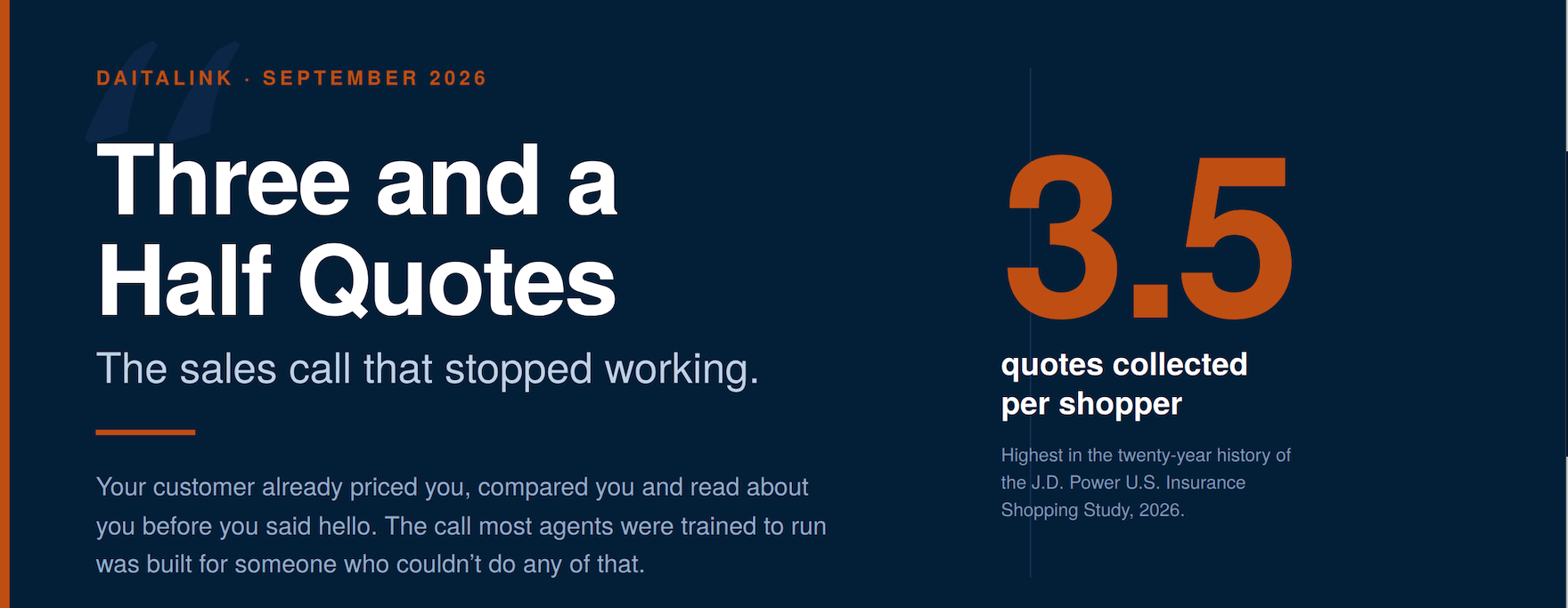
Shoppers now collect an average of 3.5 quotes — the highest number in the study’s history. Forty-eight percent of new auto policies are bought digitally, up from 36% five years ago. The share of customers shopping at all came down slightly year over year, from 57% to 53%, and still sits well above where it used to live.
Stephen Crewdson, who runs insurance intelligence at J.D. Power, put it plainly: “We’re moving from a crisis-driven market to a digital- and AI-driven market. Even as rate pressure eases, customers are getting more quotes than ever because mobile apps and AI tools make it so much easier to compare options and understand coverage.”
The same research found that shoppers who use AI somewhere in the process are more likely to switch carriers and more confident in the choice they made. Not more confused. More confident.
That is the part worth sitting with. The tool everyone assumed would overwhelm buyers with noise is instead making them feel certain. And a customer who feels certain is not waiting for you to explain the product to him.
This Is Not a Prediction About AI
It would be easy to write this as a warning about what artificial intelligence is going to do to your sales floor next year. That is not the argument, and the data does not support that version of it.
J.D. Power’s companion Digital Experience Study, run over 11,500-plus evaluations in early 2026, found that only 11% of customers interacted with a chatbot or virtual assistant at all, and that roughly a third used a price comparison tool across competing brands. AI adoption in this market is real and it is early.
Which makes the point stronger, not weaker. The buyer already got educated before most of them started using these tools. Three and a half quotes is not the future. It is the average call you took last week. Whatever AI does from here is acceleration on a shift that already happened.
And one more finding from that study, because it is the whole thesis in miniature: shoppers who used a comparison tool were nearly twice as likely to consider buying — 39% versus 21%. Letting a customer look for himself did not lose the sale. It moved him closer to one.
Why the Old Call Backfires Now
Run the classic flow against a man holding three other quotes and watch what each step turns into.
You build value. He has read the same coverage explanation twice already this week, once from a carrier’s website and once from a chatbot that had no commission riding on the answer. Yours sounds like the third recitation of something he already understood.
You present the price. He knows within a few dollars where you are going to land before you say it. If you are higher, he knew that before he answered. If you are lower, he is now wondering what got taken out.
You ask for the sale. He has been asked for the sale by everyone he spoke to. The ask has no signal left in it.
He says he wants to think about it. And your training says handle the objection, so you push — and the push is the only part of the call he will remember clearly tomorrow.
Nothing in there is bad salesmanship. Every one of those steps was correct in 1987. The method was designed around an information gap that has since closed, and running it into a closed gap converts it into something else. Pressure is just persuasion with nothing underneath it.
What He Still Can’t Get Online
Here is the part nobody has automated, and I do not think anybody is close.
A comparison engine will tell a man what four policies cost. It will not ask him what happens to his wife’s business if the truck is in a shop for three weeks. It will not notice that he mentioned his daughter turning sixteen and then move quietly to what that does to the auto line. It will not sit through four seconds of silence after a hard question instead of filling it.
A buyer can now get every fact by himself. What he cannot get by himself is a conversation that shows him something about his own situation that he had not put together yet. That is the only thing left on the call that has value, and it happens to be the one thing the old script systematically prevents — because the old script has the agent doing nearly all of the talking.
The GUIDE Method
GUIDE is the process flow we teach in place of the pitch. Five stages, in order, and the order matters more than any individual question inside it.
G — Ground. Establish who you are, why you are calling, and get actual permission to ask questions. Thirty seconds. This is not rapport-building small talk about the weather; it is earning the right to ask, so that the next four minutes don’t feel like an interrogation.
U — Uncover. Find out what he has now and how he ended up with it. Facts first, plainly, without reacting to them. Most agents skip straight past this because they already know what they want to sell. You cannot know that yet.
I — Illuminate. The prospect says the gap out loud. Not you. This is the hinge of the entire method and it carries the most weight in how we score it. You ask the question that lets him notice the thing himself — and then you stop talking and let him get there. If you name the gap for him, you have converted a realization into a claim, and claims get argued with.
D — Deepen. Now find out what that gap is worth to him. And ask for a picture rather than a number: what it would actually look like, in his business, in his week, if this were handled. Abstractions get abstract answers. Pictures get commitment.
E — Enable. Make the next step easy and remove what is in the way. By this point you are not closing anyone. He has told you what is wrong, told you what fixing it is worth, and the only thing left is whether it is simple to do.
Two rules sit on top of all five, and they are non-negotiable in the way we score a call:
- →The prospect talks more than the agent. Not marginally. Measurably. If the agent out-talks the customer, the call is capped no matter how good it sounded.
- →No pitch and no quote before a felt gap. If a number goes on the table before the customer has said what is wrong, the call is capped. A price offered into a vacuum is just a number to compare against the other three.
I Lost a Deal Proving I Was Right
I called a district office in Texas. The demo went as well as a demo goes. Then it came down to price: they wanted five seats, a competitor charged a hundred dollars a seat, and against five seats our flat monthly looked roughly five times more expensive.
So I did the math at them. There are more than a hundred agents in that district — at full rollout the competitor is ten thousand a month and we are still flat. I was completely correct. I laid it out clearly. I lost the deal.
What I should have asked was how many agents they intended to have on it a year from now, and then what that competitor’s per-seat number multiplies out to at that headcount, and then stopped talking. Same arithmetic. Different owner. If it comes out of his mouth it is his conclusion and he defends it; out of mine it is my sales argument and he resists it.
That is not a technique. That is just how people work, and it is the whole reason the method is built the way it is.
Questions Worth Asking Right Now
Before you move on, sit with these for a moment:
- →On your team’s last ten recorded calls, who talked more — and do you know the answer, or are you guessing?
- →How often does a number go on the table before the customer has said out loud what is actually bothering him?
- →If a prospect goes quiet for four seconds after a good question, can your people sit in it — or does somebody always fill the silence?
- →Does your agency have a written sales process at all — or does every producer run his own, and you find out which one when you listen to a call?
That last one catches most people. A great many agencies have no documented process flow whatsoever. They have a CRM, a lead source, and a group of people each doing it their own way. GUIDE is, at minimum, a process they can be handed.
The customer got smarter. That is not a threat to anybody who was already asking questions. It is only a threat to the part of the job that consisted of knowing something he didn’t.
Knowing the method is not the same as being able to run it under pressure, and reading five letters changes nobody’s Tuesday. Daitalink installs GUIDE as your written process flow and then runs the reps: a practice customer who pushes back the way your customers push back, scored against that standard the same way every time, followed by one specific correction — every week, for every person on the team. The full method is published in the book, and the question banks, Illuminate sequences and thirty-day schedule are free at daitalink.com/guide. What we do is make it hold.
Schedule 20 Minutes →Sources: J.D. Power 2026 U.S. Insurance Shopping Study (12,437 auto insurance quote-seekers, fielded January 2025–January 2026); J.D. Power 2026 U.S. Insurance Digital Experience Study (11,500+ evaluations, January–March 2026). Figures are industry shopping data, not measurements of any Daitalink client’s results.