Texas Senate Bill 140 took effect September 1, 2025. Search for it and you will find it described as an AI law written to rein in AI voice calling.
Read the enrolled bill. The words artificial intelligence do not appear in it. Neither does automated, in the sense people mean. There is no AI definition, no AI finding, no AI provision.
That is not good news. A law written at AI would have edges you could stay inside. SB 140 has no edges, because it is not about how the message was produced. It is about the message.
What SB 140 Actually Did
It made three changes to Texas telephone solicitation law. All three matter more than the AI story does.
- Texts are now telephone solicitations — § 302.001 was rewritten to cover "a call or other transmission, including a transmission of a text or graphic message or of an image." Every marketing text, MMS and image you send into Texas is now regulated the way a sales call always was
- Violations are now deceptive trade practices — new § 305.054 and § 304.2581 route these claims into the DTPA, which opens up attorney's fees, mental anguish damages for knowing conduct, and Attorney General civil penalties on top of the private claim
- The repeat-plaintiff defense is gone — new § 305.055 says that recovering once "may not limit recovery in a future legal proceeding in any manner." The same person can come back. This is the quiet one, and it is the one that changes the economics
What It Costs When You Get It Wrong
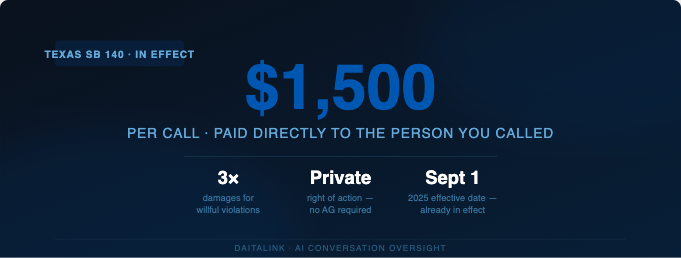
You will see $1,500 per violation quoted widely, including by law firms that should know better. That is the ceiling, not the starting point. Tex. Bus. & Com. Code § 305.053(b) entitles a plaintiff to "$500 for each violation" or actual damages, whichever is greater. Subsection (c) lets a court raise that to "not more than… $1,500 for each violation" if the violation was knowing or intentional.
The $1,500 is not a base you then triple. Anyone telling you the per-violation exposure is $4,500 has read the statute wrong.
Registration: Where Most Businesses Are Exposed
Chapter 302 requires a seller to hold a registration certificate for each business location from which a solicitation is made. The filing fee is $200 per location and the security is $10,000. Once texts became solicitations, a lot of companies that never thought of themselves as telemarketers were swept in overnight.
Two things take the edge off that, and both come with a caveat.
Consent-based texting. Texas settled a federal constitutional challenge to these registration requirements on November 6, 2025. The Secretary of State then updated its published guidance to say that a business sending text messages with the prior consent of the consumer is not required to file the registration statement, and asked the Attorney General for a formal opinion confirming it. That is real comfort, but agency guidance is not binding on a court and does not stop a private plaintiff from arguing otherwise.
Licensed insurance agents. Section 302.053(3) exempts a person holding a license under the Insurance Code where the solicited transaction is governed by that code. Read that narrowly. It is an exemption from Chapter 302 registration only. It does not exempt you from Chapter 305 liability, and it does not exempt you from the federal TCPA. Section 302.051 also puts the burden of proving an exemption on the person claiming it.
The AI Rules That Are Not Texas Law
This is where the published advice goes badly wrong, and it is worth being precise, because two widely repeated requirements do not exist.
"AI voice calls must announce they are AI at the start of the call." No Texas law says this. There is no thirty-second window anywhere in Texas statute. That language tracks FCC proposed rulemaking 24-84, floated in August 2024 and never finalized. It is a proposal, not a rule.
"Consent must specifically disclose that AI will be used." Also not Texas law, and also from that same unfinalized proposal.
Texas does have an AI disclosure statute, and it almost certainly does not apply to you. The Texas Responsible Artificial Intelligence Governance Act, HB 149, took effect January 1, 2026 as Chapter 552. Its disclosure duty in § 552.051 binds governmental agencies and health care providers. Not ordinary businesses making marketing calls. It is enforced only by the Attorney General, carries a sixty-day cure period, and has no private right of action. It is a different law from SB 140 in every respect.
What Does Bind an AI Voice Call
The real AI exposure is federal and it predates SB 140. In February 2024 the FCC issued a declaratory ruling that AI-generated and cloned voices are an "artificial or prerecorded voice" under the TCPA. That is the ruling that matters. It means a marketing call using an AI voice needs prior express written consent, and that existing rules apply: identify the business responsible for the call at the beginning, and give a callback number.
Identify the business. Not identify the AI. Those are different obligations and only one of them is law.
Texas reaches that federal standard through § 305.053(a), which creates a state cause of action for anyone who receives a communication violating 47 U.S.C. § 227 or its regulations. So federal consent failures become Texas statutory damages. That is the actual mechanism, and it is not something SB 140 invented.
One more correction worth making, because it is in a lot of compliance checklists: the requirement that consent be one-to-one and unbundled, with no pre-ticked boxes, is no longer law. The Eleventh Circuit vacated the FCC's one-to-one consent rule in January 2025, and the FCC formally removed it in September 2025. Written consent is still required. That particular formatting rule is not.
What to Actually Do
- Count your texts as calls. This is the change that caught people. If you are sending marketing SMS or MMS into Texas, you are making telephone solicitations, whether or not a human or an AI composed them.
- Get consent to the federal written standard. A signed writing, electronic signatures acceptable, with a clear and conspicuous disclosure, not conditioned on purchase. That standard is what Texas borrows, so meeting it is what protects you here.
- Settle your registration question in writing. Either register, or document which exemption you are relying on and why. If you are an insurance licensee, note that the exemption covers registration and not liability. The burden of proving an exemption is yours.
- Identify the business at the start of any prerecorded or AI voice call. Name the company responsible and give a callback number. This is a live federal requirement, unlike the AI self-announcement that is not.
- Honor opt-outs inside the workflow. Build it into the calling and texting system rather than handling it by hand afterward. Under § 305.055 a missed opt-out is not a one-time cost anymore.
- Keep the records. Consent records, call and message logs, opt-out requests, and the date each consent was captured. If you are sued, you are the one who has to prove consent existed.
- Ask your AI vendor which rule they are actually following. If they cite an AI disclosure requirement under Texas law, they are quoting a proposal that never passed. That tells you something about the rest of their compliance posture.
The Bottom Line
The risk here is not that Texas wrote a law about AI. It is that Texas widened an old law until it covered everything you send, made every violation a deceptive trade practice, and removed the rule that stopped the same person suing you twice. Whether a human or a machine wrote the message never enters into it.
Which means the compliance question is not "is our AI compliant." It is the older question: do we know what we are saying to customers, can we prove they agreed to hear it, and would we be comfortable if a court read the transcript.
Daitalink offers a free 20-minute Diagnostic — we review your public-facing AI and your team's conversations and show you where the exposure is. No pitch. Just findings.
Schedule Your Free Diagnostic →Statutory citations are to the Texas Business and Commerce Code as amended by SB 140 (89th Legislature, 2025), effective September 1, 2025. Damages figures are from § 305.053. Registration figures are from §§ 302.101, 302.106 and 302.107. This article is for educational purposes and does not constitute legal advice. Consult a licensed Texas attorney for guidance specific to your situation.